We believe that it should offer a warm, intimate, personalised experience. One where we can withdraw from the world to rest and recharge if desired, but just as easily connect to the city around us, and feel energised by it. Where a hotel’s brand is clearly expressed, but naturalised to its specific location. Where we can feel special, but also very, very comfortable. With these ideas front of mind, IF Architecture has developed an approach to hotel design based on the following five priorities.
Building a physical expression of your brand, imbued with the spirit of your hotel’s location
Brand consistency is paramount in any industry. But in hotels, the challenge for designers is to create an environment that gives expression to your brand in a way that makes sense in its urban context. We can’t roll out identical properties in every city.
Each hotel must celebrate its specific location, capture its spirit and energy as a travel destination, feel at one with it. Boutique retail brands have a similar imperative, and this can be seen in IF Architecture’s design for the Sydney flagship store for Melbourne-based furniture company Jardan.
The colour palette, for example, takes inspiration from famous local art and design families, namely John Olsen and his daughter Louise, co-founder of Dinosaur Designs, and Brett Whiteley, who have all lived and worked nearby. And the retail spaces are designed like the open, airy rooms in an inner-Sydney home.
The “beautiful but relaxed” brand identity of Jardan is unmistakeable, but it’s been filtered through the colour and light of its Sydney location.

Making destinations within destinations, a place greater than the sum of its parts
Designing hospitality and retail spaces into hotels not only builds a more robust, diversified business model, these spaces can become destinations in their own right.
They attract more people into the property, who bring with them the vibrancy of the host city. So guests feel like they can be in the hotel and in the city at the same time, and have an authentic local experience without stepping out of the front door.
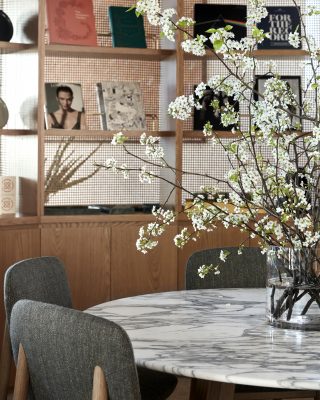
These ideas are reflected in our work at the Prince of Wales Hotel in St Kilda, where every space is designed to be part of something bigger. Hotel guests can enjoy a casual meal or drink in the ground-floor bar, which flows out into Fitzroy Street, and buzzes with a diverse crowd reflective of the local community.
For a more formal meal, they can head upstairs to the Prince Dining Room, which itself offers a range of different experiences, and is a prestigious dining destination for all of Melbourne. And next to this, the sunny open-air courtyard acts as a de facto hotel lobby, offering guests and visitors spaces to eat, work or relax.
Most recently, retail has been added to this mix, with Little Prince Wine providing locals and guests with a boutique selection of wine, as well as takeaway coffees and take-home meals. Its design draws on IF Architecture’s rich history of creating unique, immersive retail spaces, for clients ranging from Jardan, to beauty and cosmetics brands Apivita and Novae, to boutique butcher Rocco’s.
Using spatial design to deliver a warmer, more personalised guest experience
The traditional model for hotel lobbies, where guests must ask to be served by counter-bound staff, establishes a relationship – and guest experience – that is transactional and hierarchical. By contrast, intelligent spatial design can help to foster a greater sense of connection between staff and guests, where guests are truly welcomed and put at ease on arrival. It can support staff to be intuitive and proactive, engineering interactions that maintain warm relationships throughout each guest’s stay, making them feel cared for and valued.
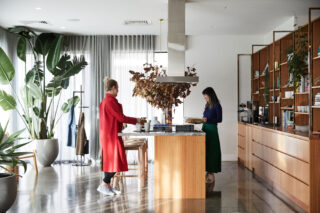
IF Architecture used spatial design in this way to disrupt the traditional model for customer service interactions in furniture retail, at our showrooms for Jardan in Melbourne, Sydney and Brisbane. Instead of being taken away to sales desks or counters to view fabric swatches or sign contracts, customers sit with sales staff on sofas or perch at a kitchen island bench with a freshly brewed coffee. All of this within an environment designed to feel more like a home and less like a shop, one that’s comfortable and anything but intimidating.
Meeting commercial and operational objectives for efficiency and profitability
Just as spatial design can shape the behaviour of staff and experience of guests, so it is key to efficiency and profitability. As architects and designers, we can configure interior spaces that reduce the amount of time and effort required of staff in fulfilling their duties. This in turn improves the guest experience through shorter wait times, reduces operating costs and improves health and safety for staff. We can also optimise the number of guests and other visitors that spaces and circulation routes can accommodate, maximising revenue streams linked to patronage.
At the Prince Dining Room, we reconfigured the floor plan with a reduced kitchen area, to support our client’s new business model, which had shifted away from the previous fine dining offering. We also removed walls and created new openings, replacing the existing arrangement of discrete dining rooms with a more open, but layered environment. Activity is now focused around formal elements in the space, including the central bar, curved banquettes and smaller dining tables, with much improved ease of circulation for staff from kitchen to table.
All of this was achieved while increasing the capacity of the restaurant by 33%
Supporting sustainability for the environment, and for business
IF Architecture treats environmental sustainability as non-negotiable, and we find that our clients do too. This applies equally to building construction and ongoing operation. For example, when pre-existing fit-outs are removed, or other demolition work is required, we seek to strip as much of the building materials and fittings as we can, for recycling or reuse. We choose natural Australian materials, such as hardwoods and natural stone, for areas where patrons and customers have contact with surfaces, so these durable materials can naturally patinate and develop character over their long lives. And we pair them with other materials, such as metals, which are deemed as “fit for purpose” in high-use commercial environments, and are effectively indestructible. As a result, our interiors stand the test of time, reducing consumption of natural resources and minimising the impact on landfill.
And of course, many of these initiatives drive sustainability in a business sense, too. For example, they reduce the costs of maintenance and future refurbishments. And for hotels, they help tell a story of respect for the environment that meets the expectations of the discerning modern traveller.